
Music, speeches, interviews, and recordings have always carried more than just simple words. Every audio file contains a unique combination of rhythm, emotion, tone, pauses, pronunciation, and human expression. But what happens when we look at sound from a completely different angle?
What happens when we reverse it?
The exploration of reverse speech has fascinated listeners for decades. By playing audio backwards, people around the world have experimented with discovering unexpected sound patterns, unusual phrases, and surprising interpretations hidden inside familiar recordings.
A Different Way to Experience Audio
Most people listen to audio only in its original direction. A song plays from beginning to end, a speech follows a natural timeline, and a voice is understood exactly as it was recorded.
Reverse playback creates a completely different listening experience.
A familiar recording can suddenly sound unfamiliar, revealing new textures, rhythms, vocal details, and patterns that were previously unnoticed. For many enthusiasts, this feels like exploring an audio landscape from another perspective.
The excitement comes from the unexpected:
- A well-known song may reveal interesting reversed vocal patterns.
- A public speech may contain surprising sound combinations.
- A spontaneous conversation may create unusual interpretations when reversed.
- A personal voice recording may become a fascinating experiment.
Discovering the Unexpected in Music
Many people enjoy exploring songs from the 1980s, 1990s, and modern music eras because these recordings often contain rich vocal layers, effects, harmonies, and complex production techniques.
Classic music from the 80s and 90s, as well as contemporary tracks, can become an interesting playground for audio exploration. Fans often revisit legendary songs, vocal performances, and artistic recordings to hear them from a completely new perspective.
Whether it is a powerful vocal performance, an emotional chorus, or a spoken introduction, reversing the audio can create surprising moments that invite curiosity.
The goal is not to replace the original meaning of a song or speech, but to explore another dimension of sound.
Speeches, Voices, and Human Expression
Human speech is naturally complex. The way people pronounce words, connect sounds, pause, breathe, and express emotions creates a unique audio fingerprint.
Reverse Speech enthusiasts often experiment with:
- interviews,
- documentaries,
- public speeches,
- podcasts,
- personal recordings,
- artistic performances.
Some listeners report hearing words or phrases in reverse playback, sometimes resembling different languages or unexpected expressions. These experiences can be highly personal and depend on individual perception, interpretation, and listening style.
Reverse exploration is best approached as a creative experiment — a way to observe patterns, sounds, and possibilities hidden inside recordings.
The Language Mystery
One of the most intriguing parts of reverse audio exploration is that listeners sometimes perceive sounds resembling words from different language families.
Examples may include patterns resembling:
- Romance languages (Spanish, French, Italian, Portuguese)
- Germanic languages (English, German, Dutch)
- Slavic languages (Polish, Czech, Russian, Ukrainian)
- Semitic languages (Hebrew, Arabic)
- Greek and other Indo-European languages
- Uralic languages
- Turkic languages
- East Asian languages
Whether these sounds are interpreted as meaningful words or simply interesting phonetic patterns, the experience can be captivating and inspires further exploration.
Create Your Own Experiments
One of the most interesting ways to explore reverse speech is by recording your own voice.
Try speaking spontaneously, without preparing a script, and then listen to the recording backwards. Many enthusiasts believe that natural, relaxed speech creates the most interesting material for exploration.
Some experimenters even record themselves after physical activity, when thoughts may flow more freely and speech becomes more spontaneous.
Explore With SMF Reverse Speech
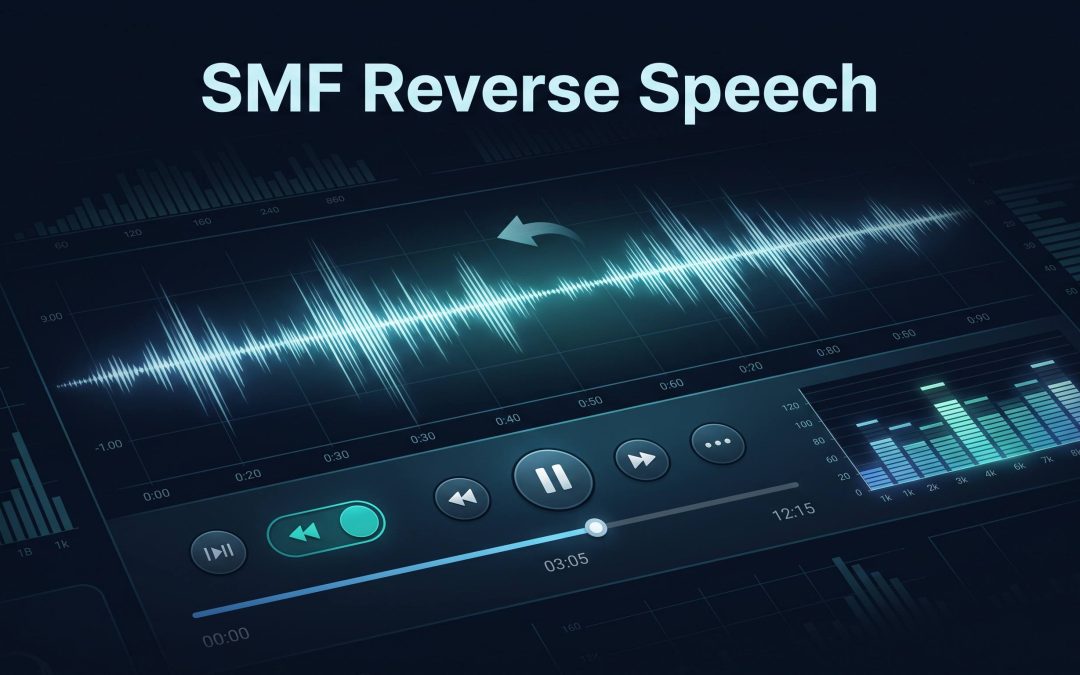
To make this kind of audio exploration simple and accessible, SMF Reverse Speech provides a dedicated reverse audio experience.
The application allows you to:
- Reverse audio files instantly.
- Slow down playback to carefully examine details.
- Speed up recordings for quick exploration.
- Use loop mode for repeated listening.
- Analyze songs, speeches, voices, and personal recordings.
With SMF Reverse Speech, every recording becomes an opportunity to discover something new.
Whether you are a music enthusiast, audio explorer, researcher of sound patterns, or simply someone who enjoys unusual experiments, reverse playback opens the door to a different way of listening.
Turn the sound around.
Listen again.
Discover what you may have never noticed before.
SMF Reverse Speech — explore the hidden side of audio.
Available via healingtools4you.com: